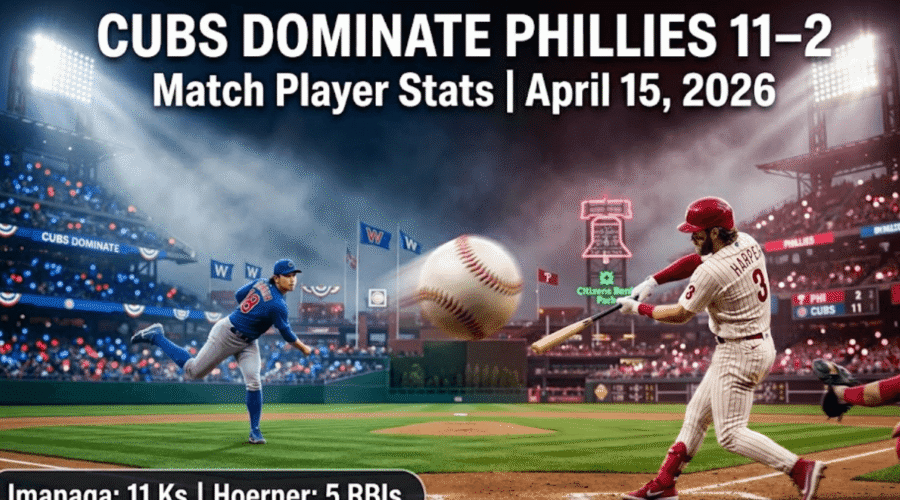
Phillies vs Chicago Cubs Match Player Stats April 15, 2026
When one team strikes out your lineup 11 times before your starter even leaves the mound, you know it is going to be a long night. That is exactly what happened on April 15, 2026, when the Chicago Cubs walked into Citizens Bank Park and dismantled the Philadelphia Phillies 11-2 in the rubber match of a three-game series. The Phillies vs Chicago Cubs match player stats from that night paint a vivid picture of two teams operating at completely different levels of execution.
Chicago brought a dominant starter, a deep and disciplined lineup, and the kind of consistent pressure that never gave Philadelphia a chance to exhale. The Phillies had flashes of power, but isolated home runs cannot compete with an offense that keeps manufacturing damage across nine innings. Whether you are here for the full chicago vs phillies scorecard, individual player breakdowns, or the analytical takeaways, this game had something meaningful to say about both rosters heading into the heart of the 2026 season.
Quick Takeaways
- Chicago scored in five separate innings and turned a close early game into an 11-2 blowout by the final out.
- Nico Hoerner went 3-for-5 with a home run, two runs scored, and a career-high five RBIs on the night.
- Shota Imanaga allowed only one earned run on three hits while striking out 11 batters across six dominant innings.
- Matt Shaw delivered three doubles in a 3-for-4 night, scoring three runs and adding two RBIs as a secondary force.
- Dansby Swanson homered and drove in two runs, ensuring the Cubs’ middle lineup gave Phillies pitching no easy innings.
- Philadelphia’s offense was anchored by solo home runs from Trea Turner and Bryce Harper but never built a sustained multi-run threat.
The Chicago vs Phillies Scorecard: What the Numbers Actually Tell You
The final chicago vs phillies scorecard reads 11-2 in favor of Chicago, but the raw line tells you even more. The Cubs finished with 15 hits and zero errors. The Phillies finished with 5 hits and 1 error. Chicago improved to 9-9 on the season; Philadelphia dropped to 8-10. Those records do not look dramatic on paper, but consider the context: the Phillies were at home, trying to win a series, and they could not produce offense beyond two solo shots.
What separates this game from a simple blowout is how Chicago built the lead. The Cubs scored in the first, third, fifth, sixth, seventh, and ninth innings. That is sustained, repeated pressure. It means Chicago never let the Phillies starter get comfortable, never let the bullpen breathe easy, and never gave the home crowd a chance to generate any real momentum. When a team scores that way, the opponent cannot simply survive one rough inning and regroup. They are constantly reacting, constantly pitching from behind, constantly needing their offense to answer a question that keeps getting harder to answer.
The Phillies have now lost three home series this season, a total that matches their entire home-series loss tally from last season. That context gives this individual game a larger meaning. One bad night happens to every team. A developing pattern is worth paying attention to, and April 15 accelerated that storyline in an uncomfortable direction for Philadelphia.
Read also: Philadelphia Phillies 2026 Home Games Schedule: Printable PDF
Nico Hoerner Led the Phillies vs Chicago Cubs Match Player Stats With a Career Night
If you search the Phillies vs Chicago Cubs match player stats from this game, one name rises immediately above the rest. Nico Hoerner went 3-for-5, scored twice, drove in five runs, and hit a home run. That five-RBI total was a career high and pushed his season total to 18 RBIs through the early weeks of 2026. That is the kind of individual performance that does not just win games; it defines narratives. Hoerner singled in the third inning to start early damage, homered in the fifth to push the lead beyond reach, and added a two-run single in the sixth to finish off any realistic Phillies comeback.
The reason Hoerner’s night matters beyond his personal line is what it did to the Phillies’ pitching strategy. When a hitter keeps coming through with runners on base, the team around him gains freedom. The rest of the lineup does not need to be perfect because they know their cleanup moments will likely be cashed. That looser approach produces better at-bats, and better at-bats produce more hits.
Matt Shaw reinforced that dynamic with one of the most productive supporting performances of the game. He finished 3-for-4 with three doubles, three runs scored, and two RBIs. Three doubles in a single game is elite extra-base production, and each one kept an inning alive longer than Philadelphia wanted. Dansby Swanson added 3 hits, 2 runs, 2 RBIs, and his own home run. Seiya Suzuki contributed 2 hits and a run. Together, the Cubs’ middle and lower-middle of the lineup functioned as a machine rather than a collection of individual hitters. The Phillies pitching had no easy outs and no safe stretches of the batting order to work through.
Shota Imanaga Made the Phillies Look Overmatched
The offensive story gets most of the attention, but Shota Imanaga’s outing was the foundation that made every Chicago run feel insurmountable. Imanaga threw 6.0 innings, gave up 3 hits, allowed 1 earned run, walked 1 batter, and struck out 11. He threw 97 pitches and generated 26 whiffs, a total that tied for the most by any Cubs pitcher in the pitch-tracking era dating back to 2008. That is not a box score curiosity; it is a statement about how thoroughly he neutralized a lineup that includes Bryce Harper, Trea Turner, and Kyle Schwarber.
When a starting pitcher generates that many whiffs, it typically means two things: his stuff is working at a high level, and the opposing lineup is struggling to make adjustments as the game develops. The Phillies struck out 12 times as a team. Some of those strikeouts came against relievers, but the tone was set by Imanaga in the first through sixth innings. By the time he left the mound, the game was already over.
Jesús Luzardo had the opposite experience on the other side. He lasted 5.1 innings and allowed 9 runs, 8 earned, on 12 hits. The walk and 4 strikeouts give him some credit for competing, but the hit total and run total reflect a night where Chicago squared up pitch after pitch. Relievers Kyle Backhus and Dylan Moore absorbed additional damage in the later innings, confirming that the Phillies’ pitching problem was not limited to their starter.
What Philadelphia Got Right and Why It Was Not Enough
Two Phillies deserve recognition despite the lopsided final. Trea Turner led off the first inning with a home run, a statement swing that briefly suggested the Phillies might set an early tone. He finished 1-for-4 with a walk, a run scored, and an RBI. Bryce Harper added a solo homer in the ninth inning, finishing 1-for-4 with 1 RBI and 1 run. Adolis Garcia had 2 hits and showed some ability to make contact, but the rest of the lineup could not build a rally around those individual moments.
This is a common and frustrating pattern for teams that rely heavily on power: the solo home run becomes the fallback instead of the bonus. When the top two hitters in your lineup are producing through the home run alone, and the surrounding lineup cannot get on base or string together hits, the home run simply keeps the deficit from being more embarrassing. Philadelphia needed a two-out RBI single in the second inning, a stolen base and sac fly in the fourth, the kind of contact-and-execution baseball that builds multi-run innings. They did not get it, and the scorecard reflects that absence clearly.
Why This Game Carries Weight Beyond April
The broader takeaway from the Phillies vs Chicago Cubs match player stats is a lesson about how winning baseball is actually constructed. Chicago’s formula was straightforward: pair a pitcher who limits traffic with a lineup that maximizes every runner it puts on base. Imanaga handled the first half of that formula with 11 strikeouts and minimal damage. Hoerner, Shaw, and Swanson handled the second half with 9 combined RBIs. That is not a lucky night; that is a blueprint.
Philadelphia, by contrast, is showing early signs of an offensive identity problem. The power is real — Turner and Harper are legitimate threats — but the lineup depth and situational hitting have not matched last season’s expectations so far. Three lost home series in the early weeks of 2026 is a trend worth monitoring. Every great team hits rough patches, but the Cubs exposed a gap on April 15 that the Phillies will need to close if they want to compete in a division that shows no signs of slowing down.
Conclusion
The April 15, 2026 matchup was a masterclass in complete team baseball from Chicago and a cautionary tale about the limits of isolated power from Philadelphia. Nico Hoerner’s career-best five-RBI night and Shota Imanaga’s 11-strikeout dominance were the headliners, but the Cubs’ 11-2 victory came from depth, discipline, and execution at every position in the lineup. The Phillies had moments of individual brilliance from Turner and Harper but could not translate that into innings of sustained offense. For anyone reviewing the Phillies vs Chicago Cubs match player stats or the full chicago vs phillies scorecard from this date, the lesson is the same one good teams apply every season: sustained pressure wins more games than singular power.
Frequently Asked Questions
Who was the best player in the Phillies vs Chicago Cubs game on April 15, 2026?
Nico Hoerner was the clear standout performer. He went 3-for-5 with a home run, scored twice, and drove in a career-high five runs. His production in the middle innings was the primary offensive engine that pushed the game out of reach for Philadelphia.
How many strikeouts did Shota Imanaga record against the Phillies?
Imanaga struck out 11 Phillies batters across six innings of work, allowing only 1 earned run on 3 hits and 1 walk. He also generated 26 whiffs, tied for the most by any Cubs pitcher since pitch tracking began in 2008.
What was the final chicago vs phillies scorecard on April 15?
The Cubs beat the Phillies 11-2. Chicago recorded 15 hits and committed no errors. Philadelphia finished with 5 hits and 1 error. The Cubs improved to 9-9 while the Phillies dropped to 8-10.
Did any Phillies hitters perform well despite the loss?
Trea Turner hit a leadoff home run in the first inning and finished with a walk and an RBI. Bryce Harper added a solo home run in the ninth. Adolis Garcia went 2-for-4. All three had moments, but none could sustain consistent production throughout the game.
What ultimately decided the Phillies vs Chicago Cubs match on April 15?
The combination of Imanaga’s strikeout-heavy pitching performance and Chicago’s lineup producing damage in multiple innings decided the outcome. The Cubs scored across six different innings, ensuring Philadelphia never had a window to mount a comeback. Hoerner’s career night at the plate and Shaw’s three doubles provided the extra-base firepower that made the blowout possible.